Tuesday, June 18, 2013

(UPDATED) TEPCO's Press Conference on High Tritium and Strontium in Groundwater Sampled Near Reactor 2 Turbine Building


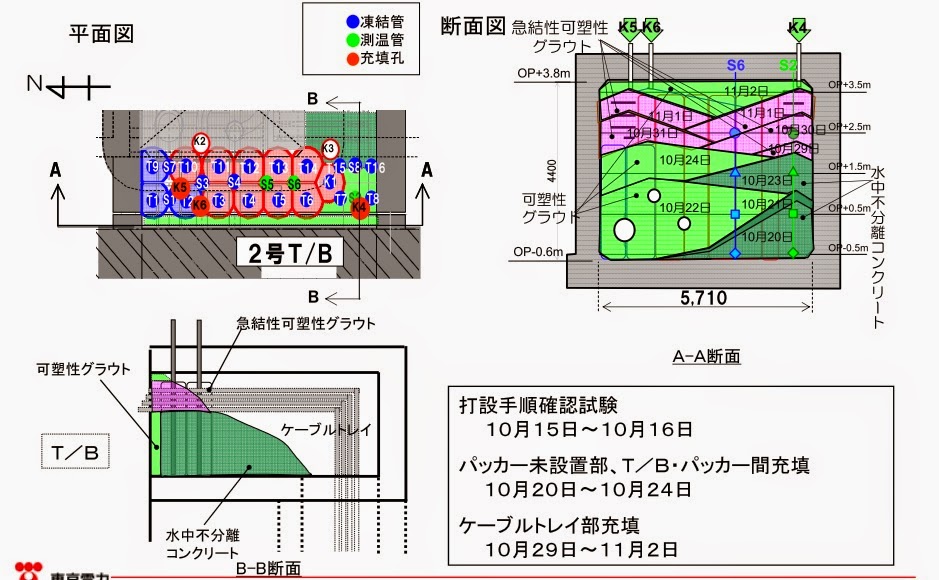
(UPDATE) TEPCO's handout at today's press conference shows that even if they didn't have the exact measurement of strontium, they had all-beta measurement that included strontium of the May 24, 2013 sample.

Compared to the December 8, 2012 sample that had 150 Bq/liter of all-beta, the May 24, 2013 sample had 1,900 Bq/liter of all-beta, one order of magnitude more. The amount of tritium also jumped by one order of magnitude. At that point, TEPCO could have said something. Instead, they again withheld the information until they had the strontium amount correct.

From TEPCO's handout for the press (6/19/2013), red rectangles added, to show the observation pit in question (No.1):


During the meeting of the Nuclear Regulatory Authority on June 19, 2013, Commissioner Shimazaki raised the issue of this tardy reporting by TEPCO, finding it problematic. But the NRA chairman Tanaka put in some kind words for TEPCO saying it would take about a month to fix the amount of strontium.

Yomiuri Shinbun (6/19/2013) reports that TEPCO was in possession of the May 24, 2013 data disclosed today (see above) as early as June 3, 2013.

TEPCO being TEPCO. Same old story that never seems to end.

=============================

500,000 Bq/liter of tritium from the water sample from May 2013, one order of magnitude higher than the sample taken in December last year (29,000 Bq/liter).

Location: Between Reactor 1's turbine building and Reactor 2's turbine building. (Compared to two other observation holes on the east side of the turbine buildings, this one shows consistently higher levels of tritium and all beta.)

1,000 Bq/liter of strontium.

Very low concentration of radioactive cesium.

(So, TEPCO has known this since late May.)

Source of contamination: past leak from Reactor 2 screen pump room. The contaminated water leak from April 2011 at Reactor 2 water intake.

Soil amendment along the east side (ocean side) of the turbine buildings, fill the gap underground.

(So, these trenches are still filled with contaminated water... All TEPCO did was to plug the exit.)

Sankei Shinbun reporter is asking, "If tritium, strontium have been discovered in the groundwater which naturally flows into the ocean, is it safe to assume this contaminated water has been flowing into the ocean?"

TEPCO obfuscates.

Did you disclose the discoveries in May and early June, he asks.

TEPCO says it was only yesterday they got the strontium data.


Press conference live feed: http://www.tepco.co.jp/tepconews/streaming/index-j.html

(UPDATED) Just In, from TEPCO's Tweet: High Levels of Strontium, Tritium in Groundwater Sampled Near Reactor 2 Turbine Building at #Fukushima I Nuke Plant


Notes from the press conference in my latest post.

============================

(UPDATE 4) It is per liter, confirms Kino. Phew. It is still very high for groundwater, supposedly not contaminated (at least not by much at all).

=============================

(UPDATE 3) Jiji Tsushin says the unit is per liter, not per cubic centimeter.

=============================

(UPDATE 2) Independent journalist Ryuichi Kino's tweet:


Strontium at a level of 10^3 (in thousands) per cubic centimeter, tritium at a level of 10^5 (in hundred thousands) per cubic centimeter. (Update from Kino, it is per liter.)

=============================

(UPDATE) "Higher than normal", says Jiji Tsushin.

=============================

Details to be discussed in the ad hoc press conference at 10AM, June 19, 2013 (Japan Standard Time).

TEPCO Nuclear's tweet, about 30 minutes ago:


We will hold a press conference at 10AM today (June 19) on the third floor of our headquarters building [in Tokyo] to explain about high levels of tritium and strontium [from the groundwater sampled] from one of the observation holes on the east side of Reactor 2 turbine building. This ad hoc press conference can be viewed via live stream.


TEPCO's live stream video page is here: http://www.tepco.co.jp/tepconews/streaming/index-j.html

Monday, June 17, 2013

#Radioactive Japan: LDP's Policy Chief Sanae Takaichi Declars "No One Has Died from Fukushima Nuclear Accident, We Have No Choice But Use Nuclear Plants"


That's how Asahi Shinbun reports. It is hard to tell for certain without the full context, but I think she meant "no one died from acute radiation sickness caused by the nuclear accident", just like many foreign experts including former NRC Chairman Gregory Jaczko (though now a changed man, it seems, after having visited Fukushima in 2012) have said over the past two years.

People in Japan who read the Asahi article are outraged. Several workers have died at Fukushima I Nuclear Power Plant while working to contain the accident. There are people who committed suicide after the nuclear accident because of radiation contamination ruining their crops and cattle. There are people who died of hunger and thirst inside the 20 kilometer evacuation zone, as officials, being bureaucratic officials, prohibited the family members from entering the zone to rescue their parents, siblings, relatives. (Why these people nonetheless followed the officials' orders is another issue.) That zone wouldn't have been set if there had been no nuclear accident. There are people who died on the way to distant shelters, who died at shelters for lack of food and heat, and who wouldn't have needed to be taken to the shelters, spending 10 or more hours on an uncomfortable bus, if there had been no nuclear accident.

But they certainly did not die from acute radiation sickness, for sure.

From Asahi Shinbun (6/17/2013):

「原発事故による死亡者は出てない」自民・高市政調会長

"No one has died from the nuclear accident", says LDP's Policy Bureau Chief Takeichi

自民党の高市早苗政調会長は17日、神戸市の党兵庫県連の会合で、「事故を起こした東京電力福島第一原発を含めて、事故によって死亡者が出ている状況ではない。安全性を最大限確保しながら活用するしかない」と原発再稼働を目指す考えを強調した。

Sanae Takaichi, Policy Bureau Chief of LDP, said in a meeting of Hyogo Prefecture LDP in Kobe City on June 17, "It is not that there has been a death from the nuclear accident, including at Fukushima I Nuclear Power Plant. We have no choice but utilize nuclear power plants as long as we secure maximum safety", emphasizing her (the party's) intention to restart nuclear power plants.

 原発事故により多くの避難者が出ている現状で「死亡者が出ていない」との理由を挙げて、再稼働方針を強調する姿勢には、批判が出る可能性もある。

Emphasizing the policy to restart nuke plants because "no one has died" may draw criticism, when there are many people displaced because of the nuclear accident.

 自民党は参院選公約の最終案で、再稼働について「地元自治体の理解を得られるよう最大限の努力をする」と推進する考えを盛り込んでいる。高市氏は産業競争力の維持には電力の安定供給が不可欠としたうえで、「原発は廃炉まで考えると莫大(ばくだい)なお金がかかるが、稼働している間のコストは比較的安い」と語った。

The final draft of LDP's campaign promise for the coming Upper House election includes the push for restart of nuclear power plants by saying the party will "make maximum effort to win the understanding of local municipalities". Ms. Takaichi said the stable supply of power is indispensable for maintaining the competitiveness of industries, and that "a nuclear power plant costs enormous amount of money if we think about the cost of decommissioning, but while it is operating the cost is relatively cheap."


Her boss, Prime Minister Shinzo Abe, has been busy peddling Japanese nuclear power technologies and plants in Asia and central Europe, saying his country has learned the lessons from Fukushima and the country's nuclear technology is better than ever.

In other words, après moi, le déluge.

#Fukushima I Nuke Plant: TEPCO's PR Shouts At Italian Journalist, "If You Cannot Follow My Orders, Go Back!"


On June 13, 2013, TEPCO invited foreign correspondents to Fukushima I Nuclear Power Plant to show them the progress that's been made at the plant.

Mr. Pio d'Emilia is the Far East correspondent for SkyTG24, an Italian news TV, who went on the tour, only to be solded down by an agitated TEPCO employee for asking to see the "cage" (steel frame structure over the Reactor 4 building that TEPCO has just recently completed).

As Mr. d'Emilia says, the whole purpose of the tour was to show the "cage" over the Reactor 4 building...

He sarcastically writes, "This was worse than North Korea!"

From Daily NO BORDER entry (6/17/2013; part) by Pio d"Emilia, (original in Japanese, my English translation):

東電の広報室の人たちというのは、じつに奇妙奇天烈だ。自分たちから報道陣を呼んでおきながら、仕事を妨害し、終始怒鳴り続ける。ざるのごとく汚染水が漏れ続けているにもかかわらず、福島第一原発は「きちんと管理」され、現在は「安全な」状況にあり、収束作業は「予定通り」進んでいると我々に思い込ませようと必死のあまり、報道陣から一瞬たりとも目を離さない。「皆さんの安全を第一に考えて」というもっともらしい言い訳のもと、立ち止まることも許さず、レンズの前に手を置いて撮影を制止する。これではまるで北朝鮮の警備兵より酷いです。

TEPCO's PR people are a really weird bunch. They are the ones who invited journalists to the plant. But they obstruct our work, and shout at us non-stop. Contaminated water has been leaking like sieves, but they do their utmost best to convince us that Fukushima I Nuke Plant is "properly managed", and it is in "safe" condition, and work is proceeding "according to schedule". So they keep an eye on us all the time. Under the pretext of "we consider your safety first", they don't allow us even to stop for a moment, they put their hands on our camera lenses to stop us from taking pictures. This is worse than a North Korean armed guard.

彼らはいったい何を恐れているのか。安全を脅かされること? だが、安全なんてどこにあるのか。そもそも、適格な能力もないくせに、無責任にも原子力発電所を建設し、運営し続けることによって、公共の安全を著しく侵害したのは、東電ではなかったのか。

What are they afraid of? Having safety threatened? But where is that safety? Wasn't it TEPCO to start with, who built nuclear power plants irresponsibly, without qualified competence, who continued to operate the plants and by doing so severely harmed public safety?


(Full article at the link)

In the video Mr. d'Emilia links, a TEPCO PR person is shouting with agitated gesture with his arms, his anger totally out of proportion. I have no idea why he should be angry to begin with. (Dialog in Japanese, my translation):

d'Emilia: "I would like to see the new "cage"."

TEPCO PR: "100 meters ahead!"

d'Emilia: "I would like to see that."

TEPCO PR: "We're going to walk there! Keep calm! You hear me? If you cannot follow my orders, go back! Understand?"

d'Emilia: "Wow wait a minute. I'm just asking questions..."


TEPCO's PR person was having a bad full-face mask day, I suppose.

#Fukushima I Nuke Plant: Photographs of Bad Weld in ALPS Batch Treatment Tank That Leaked


TEPCO released the photographs of the weld that leaked highly radioactive water that was going to the Line A of ALPS multi-radionuclide removal system at Fukushima I Nuclear Power Plant.

The photographs are not big enough to see the details of the weld clearly, but it looks like a poor weld. Another rush job, I suppose.

From TEPCO's Photos and Videos page, 6/17/2013:


Overview of ALPS by TEPCO, here.

ALPS stands for "Advanced Liquid Processing System", developed by Energy Solutions in Salt Lake City, Utah.

I wonder which subcontractors of Toshiba did the welding of these tanks being used in the ALPS system. The weld in the photos above sure doesn't look like a "nuclear power plant" grade.

Sunday, June 16, 2013

#Fukushima I Nuke Plant: Highly Radioactive Water Leak (6,700 Bq/cm3 All Beta) from ALPS, Hot Run Halted


The leak is apparently from the weld. Either they can't weld, or they can't test the weld. Or both.

The water that leaked is after the treatment by SARRY, also a Toshiba system, to remove radioactive cesium.

If you recall, SARRY, Toshiba's cesium absorption system, had a leak in February 2012 from what was clearly a defective weld of a pipe connected to the cesium absorption tank.

From Asahi Shinbun (6/17/2013):

高濃度汚染水漏れか 福島原発、放射性物質除去装置停止

Highly contaminated water leak at Fukushima I Nuke Plant, multi-nuclide removal system (ALPS) stopped

 東京電力は16日、福島第一原発で3月末に試験運転を始めた放射性物質除去装置「ALPS(アルプス)」のタンクから、処理前の高濃度汚染水が漏れた疑いがあると発表した。タンク表面の溶接部の放射線量は毎時0・2ミリシーベルトと高い。東電は原因を調べるために試験運転を止めた。

TEPCO announced on June 16 that a leak was suspected from one of the tanks at "ALPS", multi-nuclide removal system in Fukushima I Nuclear Power Plant that TEPCO had started to test at the end of March. Highly contaminated water before the treatment by ALPS may have leaked. The surface radiation at the weld of the tank is high, at 0.2 millisievert/hour. TEPCO has stopped the test run to investigate the cause of the leak.

 4月に誤操作で停止したことはあるが、トラブル調査で止めるのは初という。

It is the first time to stop ALPS due to trouble, TEPCO says, although the system stopped in April because of human error.

 東電によると、タンクは高さ約6メートル、直径約3メートルの円柱形で、汚染水約25トンが入っていた。15日午後11時ごろ、タンクの結露を調べていた社員が、タンクの受け皿部分で茶色の水滴の跡を見つけた。タンク表面にある溶接部の線量が周辺より高いため、溶接部から汚染水が漏れたとみている。

According to TEPCO, the cylindrical tank of 6 meters high and 3 meters in diameter contained about 25 tonnes of contaminated water. At 11PM on June 15, a TEPCO employee who was inspecting the condensation on the tank found dried water spots in brown color on the saucer (receptacle) of the tank. The weld on the surface of the tank was found with higher radiation, and it is assumed that the contaminated water leaked from the weld.

 ALPSは、高濃度の汚染水からストロンチウムなど62種類の放射性物質を取り除くことを目指して導入する装置。汚染水の漏れが確認されれば、タンクの交換などで7月末を目指していた試験運転の完了がその分遅れる。

ALPS is being introduced to remove 62 types of radionuclides including strontium from the highly contaminated water. If the leak is confirmed, the tank will have to be replaced, which will delay the completion of the test run scheduled to run till the end of July.

 A、B、Cの三つの系統があり、止めるのは3月30日から試験運転中のA系統。B系統は今月13日に試験運転に入ったばかりで、C系統はまだ試験運転を始めていない。

There are three lines, A, B and C, in ALPS. The A line, which has been on a test run since March 30, will be stopped because of this leak. The line B has been on a test run since June 13, and the line C hasn't been tested yet.


TEPCO says in their latest email notice to the media (6/17/2013) that they tested the water they collected in a bucket. Beta is high:

 当該タンク下に滴下水を受けるためのバケツを設置しておりましたが、昨日(6月16日)から約16時間バケツで受けた滴下した結露水(370ml)の核種分析を行った結果、以下の通りでした。

We placed a bucket under the tank to collect the drips. We tested the water (370 milliliters) collected over 16 hours since yesterday (June 16), and the results are as follows:

【バケツに受けた水の核種分析結果】
 ・セシウム134 :1.9×10^0[Bq/cm3]
 ・セシウム137 :3.9×10^0[Bq/cm3]
 ・全ベータ核種:6.7×10^3[Bq/cm3]

Cesium-134: 1.9×10^0[Bq/cm3] (or 1.9 Bq/cm3)
Cesium-137: 3.9×10^0[Bq/cm3] (or 3.9 Bq/cm3)
All beta: 6.7×10^3[Bq/cm3] (or 6,700 Bq/cm3)

Saturday, June 15, 2013

(OT) Descendants of a Japanese Diplomatic Delegation from 400 Years Ago Greet Japan's Crown Prince on His Visit to Spain


There are about 700 people in the town of Coria del Río in Seville, Spain whose surname is "Japón" (originally "Hasekura de Japón", according to Wiki). They are considered to be the descendants of a Japanese diplomatic mission headed by Tsunenaga Hasekura from 1613 through 1620. Hasekura was sent on a global mission by his lord Masamune Date of Sendai-han (that includes today's Miyagi Prefecture).

It is known that 7 or so of his delegates decided to remain in Coria del Río, and their descendants started to use the surname of "Japón".

Japan's Crown Prince is on an official visit to Spain, and met with the "Japóns" in Coria del Río, proud descendants of the Hasekura delegation, as Asahi Shinbun reports (6/15/2013):

日本との交流400周年を迎えたスペインに、日本を意味する「ハポン」という名字の人たちがいる。その数、1500人。400年前にスペインに渡った支倉常長ら「慶長遣欧使節団」の子孫とされる。14日夜(日本時間15日未明)、同国南部のセビリア市にハポンさんが集い、皇太子さまと懇談した。

It's been 400 years since Spain and Japan first made contact. There are people with the surname "Japón", meaning Japan, in Spain. There are 1,500 of them. They are considered to be the descendants of "Keicho Delegation" led by Tsunenaga Hasekura, who went to Spain 400 years ago. In the evening of June 14, "Japón" people got together in the city of Seville in southern Spain and met with Crown Prince of Japan.

使節団は1614年、セビリア近郊の市コリア・デル・リオに滞在。7人前後が帰国しなかったことが分かっており、郷土史家らは「子孫らが祖国ハポンを名乗り始めた」という説を唱えている。

The delegation stayed in Coria del Río, near Seville, in 1614. It is known that seven or so of the delegation didn't go back to Japan. Local historians believe the descendants of these people started to use the name of their home country Japan as their surname.

ハポンさんたちも日本とのつながりを強く意識する。14日昼にコリア・デル・リオを訪れた皇太子さまを、ハポンさんを中心に1万人近くが出迎え、「ハポン!」コールを上げた。「支倉常長協会」会長のファン・フランシスコ・ハポンさん(44)は「ハポンの名字にみんな誇りを持っている。日本人の特徴である蒙古斑(もうこはん)がある人も少なくない」と話した。

"Japón" people are keenly aware of their connection to Japan. Nearly 10,000 residents including "Japón" people greeted Crown Prince in Coria del Río on June 14 afternoon, chanting "Japón!" Juan Francisco Japón (age 44), chairman of "Hasekura Tsunenaga Association", said, "We are all proud of our surname Japón. Some of us have the Mongolian spots like Japanese."

ファンさんによると、東日本大震災後、ハポンさんたちは支援活動に奔走した。支倉の銅像前で黙祷(もくとう)を呼びかけ、募金やチャリティーオークションをした。コリア・デル・リオもホームページで「こちらに避難したい方には市民権を与えます」と日本向けに発信したという。

According to Juan, after the March 11, 2011 disaster in Japan, "Japón" people did all they could to help Japan. They called for silent prayers in front of the statue of Hasekura, they did fund raising and charity auctions. The town of Coria del Río called to people in Japan on their website, offering citizenship to anyone who wants to escape Japan and come to the town.

1991年に宮城県石巻市を訪問したビクトル・バレンシア・ハポンさん(48)は「石巻の被災後の映像を見て、私たちの遠い親族が被災したかも知れないと思うと、とてもショックだった」と振り返る。

Victor Valencia Japón (age 48) visited Ishinomaki City in Miyagi Prefecture in 1991. He said, "I looked at the images of Ishinomaki after the disaster, and it was very shocking to me, thinking our distant relatives may have been affected."

14日夜、セビリア市のホテルに約30人のハポンさんが集まった。「サムライ精神を持つことが誇らしい」「日本とスペイン交流の懸け橋になりたい」。思いを訴えるハポンさんたちに、皇太子さまは「日本の名前が付く方々にたくさんお会いできて本当にうれしいです」と笑顔を見せた。

In the evening of June 14, 30 "Japón" people gathered at a hotel in Sevilla. They said to Crown Prince, "I'm proud to be the descendant with Samurai spirit", "I want to help in deepening the relationship between Japan and Spain." Crown Prince smiled, and said "I am very happy to meet so many of you with the name Japan."

参加したフェルナンド・ハポン・セビリアさん(49)は「日本由来の400年の歴史を持つハポン姓の私たちにとって、とても名誉な日だ」と語った。

Fernando Japón Sevillia (age 49) said, "For us, with the surname Japón with 400 years of history, this is a very honorable (proud) day."


I didn't know anything about these people in Spain with the "Japón" surname until I read the Asahi article. How wonderful to know there are people in the world proud to be of Japanese lineage (alleged or not proven, it doesn't matter) who continue to care about their very distant "home" country from 400 years ago.

Hundreds in Hong Kong Protest NSA Surveillance, Support Snowden


Both pro-China legislators and anti-Hong Kong government protesters are upset with the US government snooping.

One sign carried by a Hong Kong resident reads, "Protect Snowden. Protect Freedom."


From USA Today (6/15/2013):

Hundreds in Hong Kong protest NSA surveillance

Zach Coleman

HONG KONG — In a show of protest against U.S. surveillance programs and in support of whistle-blower Edward Snowden, several hundred people marched Saturday to the U.S. Consulate General and the offices of the Hong Kong government despite drizzly weather.

"I think it's not acceptable for the (National Security Agency) to spy" on everyone, said Patrick Cheung, who has been upset by claims former NSA contractor Snowden made about the agency's data gathering from U.S.-based Internet firms. "It's our right to have our privacy protected."

"Shame on NSA! Defend freedom of speech!" chanted marchers, who carried signs written in Chinese and English and wrapped in plastic to keep out the rain. "Protect Snowden!"

The march, backed by five opposition parties and 22 other organizations, included the presentation of protest letters addressed to U.S. Consul General Steve Young and the head of Hong Kong's government.

"We request you to stop running these surveillance programs against innocent Internet users in Hong Kong and around the world," read the letter to Young.

Before the rally, several representatives of a pro-China political party marched to the consulate to call for an end to the alleged U.S. hacking of Hong Kong computer systems, an allegation Snowden made to a local newspaper earlier in the week after he fled to the city.

Meanwhile, half of respondents in a survey of 509 residents conducted by university researchers on behalf of the South China Morning Post said they opposed the Hong Kong government turning Snowden over to U.S. authorities, while a third of respondents said they considered the NSA whistle-blower a hero.

"We are glad Snowden is brave enough to expose all the U.S. government's evil deeds," said James Hon, who marched Saturday as a leader of the League in Defence of Hong Kong's Freedom, a group that commonly participates in anti-Hong Kong government protests. "We should let Snowden live in Hong Kong and express his views freely."

Several Hong Kong legislators addressed the rally, and others are planning to raise Snowden's allegations of U.S. hacking into Hong Kong computers with government ministers at a session Wednesday. Two legislators sent their own letter addressed to President Obama saying the NSA surveillance programs had "set a dangerous precedent and will likely be used to justify similar actions by authoritarian governments".

Back at the rally, marcher Venus Hui expressed a simple hope for the man at the center of the controversy.

"I hope Snowden can go back to the U.S. one day," he said.

Friday, June 14, 2013

#Fukushima Medical University Distributed Potassium Iodide to Medical Staff on March 15, 2011, Says It Was Their "Vested Interest" As Medical Professionals


as radioactive materials were falling on people waiting outside to get drinking water and food.

A short blog post by Minamisoma City Assemblyman Koichi Ooyama contains a link to a religious newspaper article that recounts the early days of the nuclear accident in March 2011 and how people are trying to recover from the disaster by decontaminating their place.

In the June 6, 2013 article, the author Koyu Abe, a Zen Buddhist monk in Fukushima City, says the following:

当時の放射性ヨウ素の貴重なデータがある。福島市の南東に位置する県立医大近辺で3月15日(爆発から3日後)に採取された葉菜の検査記録だ。県が測定し手書きで残したその資料には、ヨウ素だけで1キロあたり119万ベクレルが検出されたことが示されている。

There exists a valuable piece of data about radioactive iodine in the early days of the accident. It is the record of measuring leafy vegetables taken near Fukushima Medical University [located just south of Fukushima City center] on March 15 (three days after the explosion [of Reactor 1]). The handwritten data by the prefectural government shows 1.19 million becquerels/kg of radioactive iodine.

当時医大で医師・看護師などに「安定ヨウ素剤」を配ったのも頷けるデータだ。しかし、私たちにはそうしたデータが公表されることはなかった。

Looking at this number, it is understandable that Fukushima Medical University distributed potassium iodide pills to doctors and nurses. However, this data was never disclosed to us.

今年の1月、法務省主催の人権フォーラム「震災と人権」でパネリストを務め、こうした事実を伝えた。ところが、後日主催者から報告文書中のこの発言内容について削除したい旨の電話が入った。

In January this year, I served as a panelist in a human rights forum sponsored by the Ministry of Justice called "March 11, 2011 disaster and human rights", and I talked about this fact. However, the sponsor called me later and said they would like to delete my comments from the report.

医大関係者から「それは医療従事者の既得権益で、なんら問題がない」という意見が寄せられたためだ。私は「百歩譲ってそれを認めたとしても、地震により当時ライフラインの復旧のために何週間もの間、文字通り寝食を忘れ、大量の放射性物質が降り注ぐ中、復旧工事に従事していた人にはなぜ配られなかったのか。彼らには既得権益はないのか」と一蹴すると、1時間足らずで「削除せず、そのまま記録する」との返答があった。明らかな職業差別であったからだ。

Officials at Fukushima Medical University had raised issues with the sponsor by saying "It [distributing potassium iodide pills] was our vested interest as medical professionals, and there should be no problem with that."

I protested and said, "For argument's sake let's assume it is true. But there were people at that time working hard day and night for weeks on end, literally without sleep and food, in order to restore life lines after the earthquake while a large amount of radioactive materials were falling on them. Why didn't they get the pills? Why didn't they have vested interest?" One hour later, they called me back and said my comments wouldn't be deleted, and would be recorded as they were. It was clear that [the University's argument] was discrimination based on occupation.


Mr. Abe is the one who decided to use his temple to store contaminated soil removed from people's homes, three months after the start of the accident.

On March 15, 2011, I remember reading about people in Fukushima, particularly in Fukushima City, standing outside in long lines in the snow for a long time to get some drinking water, with mothers and fathers taking their kids with them.

Reactor 3 building blew up at 11AM on the previous day, March 14. They were trying to vent Reactor 2 all night and early morning of March 15. Reactor 4 building managed to blow up (no one knows how) in the early morning of March 15, and at about the same time some event did happen in Reactor 2's Suppression Chamber.

On March 15, 2011, I was writing about:

#Fukushima I Nuke Plant: Maybe a Level 7 Disaster

#Fukushima I Nuke Plant: Reactor No.4 Radiation Abnormally High, Government Asking US Military to Spray Water From Air

On March 16, 2011, I was screaming about the first evacuee death due to lack of water, heat, and food, while the official depots were swimming with foods, water and blankets and clothes from people from all over the world.

Hardly anyone was reading my blog then, but I had to write to keep some sanity. It still feels like only yesterday.

San Onofre Closure a Financial Decision, Nuclear Power Far From Over, Says Oilprice.com


I don't see anything wrong with shutting down nuclear power plants like San Onofre in southern California because of cost consideration, not because of safety consideration. A shutdown is a shutdown.

From Oilprice.com newsletter (6/14/2013), part:

But the big “upset” story this week—for those not lured away by the sexier news of the NSA’s digital surveillance reach—is the permanent closure of the San Onofre nuclear plant and the ensuing regulatory battle Edison International (EIX) will have to fight over who is going to foot the bill here. It will cost around $3.4 billion to retire the nuclear plant. The plant is owned by Southern California Edison, which has invested $2.1 billion in San Onofre’s two nuclear reactors, and now finds that it could end up paying $1.3 billion in refunds for customers who paid since the plant stopped producing power in January last year when the reactors were shut down after a radioactive leak was discovered.

The San Onofre story is the continuation of a story that began in earnest when the shale gas boom turned nuclear endeavors into economic nightmares. This year has seen the closure of four other commercial nuclear power units so far. Since then the idea of possibly restarting the reactors proved to come along with costs that wouldn’t be recouped and significant regulatory hurdles. Existing nuclear reactors are becoming increasingly too expensive to maintain, and questions of safety rise in tandem with costs that question commercial viability. But it’s not the beginning of the end for nuclear; it’s just the beginning of the beginning, and a future (still quite a long way off) where small modular reactors (SMRs) will take center stage.


The "San Onofre" link in the article goes to June 7, 2013 Bloomberg article, in which the CEO of Southern California Edison says it's cheaper to buy power on the open market:

“It no longer makes sense to restart San Onofre,” Craver said today. Buying power on the open market became the cheaper alternative because a year of delay cut too deeply into its operating life, he told reporters. The reactor license expires in 9 years. Edison was spending $30 million a month preparing for the restart, he said.


The Obama administration is funding Babcock Wilcox to design and commercialize small modular reactors.

CNBC: Is an Overconfident BOJ to Blame for Market Woes? Is BOJ a Market Virus?


(My personal answers are yes and yes.)

Political and financial elites full of themselves rule Japan, so what else can you expect?

From CNBC (6/13/2013; emphasis is mine):

Is an Overconfident BOJ to Blame for Market Woes?

By: Ansuya Harjani, Assistant Producer, CNBC Asia

Since stunning the markets with unprecedented monetary easing in April, the Bank of Japan has taken a back seat, failing to offer solace to investors that have been rattled by violent swings in the country's bond and equity markets.

According to Kathy Lien, managing director, BK Asset Management, the central bank's "overconfidence" is to blame for the instability plaguing the market.

"They did nothing because they were stubborn and overconfident that their policies were enough to stabilize markets and the markets said no," Lien told CNBC Asia's "Squawk Box" on Friday.

"This is Japan's own doing, they had the opportunity to provide markets with a small dose of stimulus in the form of increasing asset purchases or even the maturity on fund supply operations and they did nothing," she added.

Lien was referring to the BOJ's meeting this week when the central bank failed to announce additional measures like increasing the maturity on its fixed-rate loan facility to two years from one year.

Prime Minister Shinzo Abe's recent announcement of his longer term growth strategy which fell short of expectations, coupled with the disappointment with the BOJ has forced investors to reassess their outlook for the market.

... "They [BOJ] feel their weekly operations are sufficient to calm the [bond] market volatility - The market is saying the BOJ needs to be a little more active than that," she said.

At this point, Japan watchers say it is vital that BOJ Governor Haruhiko Kuroda betters his communication with the market in order to restore investor confidence.

It's a failure to communicate. For example, the governor of BOJ saying 'I think we've done enough' is the wrong thing to say. The correct thing to say is that 'There is no limit to what we are prepared to do'. The psychology is really important with this," said Nicholas Smith, Japan strategist at CLSA.

In April, Kuroda said the Bank of Japan's plans to double the monetary base would be enough to achieve its 2 percent inflation goal, noting that the central bank has taken all the "necessary" and "possible" measures.

A contrast from European Central Bank Chief Mario Draghi who pledged to do"whatever it takes" to save the euro zone last year.

With investors on edge in the face of uncertainty over when the Federal Reserve will begin scaling back its bond buying program, it has become increasingly important for major central banks to clearly communicate their intentions, said strategists.

David Kotok, chief investment officer, Cumberland Advisors, agrees, noting that recent havoc in global markets is largely a result of poor communication by both Kuroda and Bernanke.

"You had a failure to communicate in two central banks at the same time - two of the G-4 botched it up. Bernanke did - he sent a mixed message and stirred a pot. The BOJ has done the same," he said.

(Full article at the link)

Thursday, June 13, 2013

"Eat and Support the Recovery of #Fukushima" Food Fair at TEPCO Headquarters Was a Great Success


According to Denki Shinbun (6/13/2013), an electric power industry newspaper:

食べて支える、福島復興-東電本店で食材販売バザール

Eat and support the recovery of Fukushima - Food fair held at TEPCO Headquarters

東京電力本店で福島県の食材を販売する「福島復興バザール」が、今月11日に開催された。福島県産のトマトやサクランボ、日本酒、喜多方ラーメンなどが売り場に並び、行列ができるほどの盛況ぶりだった。社員食堂でも福島スペシャルメニュー「食べる豚汁」が同日限定で販売され、好評を博した。食材販売にあたった社員は、「福島県産の食材を食べることで、復興の一助になればと思う。色々な活動を通して復興を支援していきたい」と話していた。

"Fukushima Recovery Bazaar" to sell foodstuff from Fukushima Prefecture was held on June 11 at TEPCO Headquarters in Tokyo. Made-in-Fukushima tomatoes, cherries, sake, Kitakata ramen noodles were displayed, and people formed long lines to buy them. At the company cafeteria, "soup with pork" was the very popular day's special. A TEPCO employee in charge of selling the foodstuff said, "We hope eating foodstuff made in Fukushima Prefecture will help the recovery of Fukushima. We will continue to support the recovery through various activities."

(Wag the Dog) US Decides Syrian Government Used Chemical Weapons Against Rebels (and Not the Other Way Around)


(UPDATE 2) Washington Post reports (6/14/2013) CIA is preparing to deliver arms to rebels in Syria via clandestine bases in Turkey and Jordan. The government officials, including Obama's speechwriter-turned-advisor Ben Rhodes, are quoted in the article expressing confidence that they know who are the "good" rebels and who are the "bad" rebels. Trust us, they are saying...

================================

(UPDATE) By the way, a war game is underway in Jordan, called "Eager Lion 2013". How coincidental. 18 nations join the US. 5,000 Americans from all services, including Marines, participate.

================================

Benghazi scandal

Phone records scandal

DOJ Spying on journalists scandal

IRS scandal

State Department sex and drug ring scandal

NSA leak and snooping scandal

Blitzkrieg on the Obama administration and President Obama has finally succeeded. So, now,

"U.S. Concludes Assad Used Chemical Weapons Against Rebels"

Time for direct military support including training rebels in Jordan, and no-fly zone out of Jordan. (I see. That's why NSA was very busy collecting intelligence out of Jordan in March this year.)

Didn't UN say it was the so-called "rebels" who may have used sarin gas? Don't bother with details, I guess.

From Bloomberg (6/13/2013):

The U.S. has confirmed that Bashar al-Assad’s regime in Syria used chemical weapons against rebels and will escalate deliveries of military aid to opposition forces, an administration official said.

Assad’s forces used the nerve gas sarin on a “small scale” several times against the opposition, causing 100 to 150 deaths, Ben Rhodes, Obama’s deputy national security adviser, told reporters on a conference call.

The U.S. is stepping up assistance to the Syrian opposition, including aid that would have “direct military purposes on the ground,” Rhodes said, without elaborating. He refused to say whether that would include weapons.

“We’re just not going to be able to lay out an inventory of what exactly falls under the scope of that assistance,” Rhodes said. He said the administration has “not made any decision to pursue” establishing a no-fly zone over Syria.

“We’ve prepared for many contingencies,” he said.

(Full article at the link)


And Wall Street Journal (6/13/2013) on Jordan:

WASHINGTON—A U.S. military proposal for arming Syrian rebels also calls for a limited no-fly zone inside Syria that would be enforced from Jordanian territory to protect Syrian refugees and rebels who would train there, according to U.S. officials.

Asked by the White House to develop options for Syria, military planners have said that creating an area to train and equip rebel forces would require keeping Syrian aircraft well away from the Jordanian border.

To do that, the military envisages creating a no-fly zone stretching up to 25 miles into Syria which would be enforced using aircraft flown from Jordanian bases and flying inside the kingdom, according to U.S. officials.

The White House is currently considering proposals to arm the rebels in Jordan, according to U.S. officials. White House National Security Council spokeswoman Caitlin Hayden declined to comment on the details of those deliberations.

The limited no-fly zone wouldn't require the destruction of Syrian antiaircraft batteries, U.S. officials said.

Officials said the White House could decide to authorize the U.S. to arm and train rebels in Jordan without authorizing the no-fly zone recommended by military planners. A White House announcement could come soon, officials said.

(Full article at the link)


Wall Street Journal says "officials" but it looks the "officials" are Mr. Ben Rhodes.

His entry on Wikipedia says he has been Obama's foreign policy speech writer since 2007. His brother is the president of CBS. For more about Mr. Rhodes, here's one link that is informative.

Right on cue, the usual suspects issue their joint statement praising the administration's decision.

The Obama administration, with the strong support from politicians like Graham and McCain, will support the "rebels" who executed a 14-year-old boy in front of his parents because the boy "insulted Islam".

Totally irrelevant but not knowing it, Japan's Prime Minister Abe is likely to announce at G-8 that Japan will join the EU and the US in directly supporting the Syrian "rebels", without ever wondering who these "rebels" are. He is just desperate for Japan to join the winning side.

PM Abe's Chief Cabinet Secretary Stating the Obvious: "When Yen Was Higher, Yen Was Much Higher"


Thursday humor to tide you over to Fabulous Friday...

From Chief Cabinet Secretary Yoshihide Suga, on the second largest plunge of Nikkei this year and Japanese yen melting up past 94 yen (for a moment), according to Reuters Japan (6/13/2013; part):

「円高の際には76円までいったのだから。現在は1ドル94円。安倍政権の発足時に比べたら、株価は4割くらい上がっており、為替もきょうは円高に振れたとはいえ、15円くらい円安になっている。そうした動きは一喜一憂することではない。株価は必ず調整局面があるのだし、実体経済や先行指標は間違いなくよい方向にあり、自信をもって政策を推進していきたい」

"When yen was higher, it went to 76 yen. Right now it is 94 yen against US dollar. Share prices are up by 40% now, compared to when the Abe administration came into power, and yen is 15 yen cheaper now, even though it was higher today. Such movements are nothing to worry about. Share prices adjust, real economy and leading indicators are definitely on the mend. We would like to execute our policies with confidence."


As if real economy (aka "main street") matters to algo bots and macro investors. In case you think like Suga, it doesn't. In addition, Mr. Suga seems to already and conveniently forgot that one of the leading indicators for private capex (capital expenditure), machine order, plummeted by 8.8% in April.
Close your eyes and click your heels three times...

When Reuters Japan initially reported the news, Suga's comment was extremely succinctly summarized, as:

「円高の時は、もっと円が高かった」

"When yen was higher, yen was much higher."


Exactly, Mr. Suga.

Suga also quoted Bank of Japan Governor Kuroda telling the Abe cabinet that the stock plunge is just a normal profit taking.

Exactly, Mr. Kuroda. It's also called "bear market".

Congratulations by the way for having the first major stock index in the world that has plunged down to a bear market territory (i.e. 20% correction from the top). Japan as the world No.1!

One glimmer of hope for Suga, Kuroda, and Abe, maybe, is that Goldman Sachs, who had recommended long Nikkei September futures in anticipation of BOJ's meeting results on Tuesday, is sticking to the recommendation even after the stop loss was triggered, according to Zero Hedge (6/13/2013):

...Instead, Goldman flagrantly ignores its own stop loss, and continues keeping the muppets in what is now a losing trade, and massively losing if one applied leverage.

The overnight price action in Asia has been extremely volatile, with all major equity bourses deeply in the red. The Nikkei closed more than -6% lower (and the Topix about -5%), with the JPY trading through 93 at one point (last 94.5). These sharp moves have also meant that the Nikkei September future traded through our stop of 12,700... Stay long Nikkei September futures (NKU3), opened at 13,215 on 10 June 2013, with an initial target of 14,500 and a stop on a close below 12,700, currently at 12,400.

Translation: Goldman has quite a bit more NKU3 in inventory to sell to muppets. And muppets, clueless as always, are gladly obliging.


(UPDATE) Goldman apparently exited the trade, according to Zero Hedge.

Wednesday, June 12, 2013

Japan's Nikkei Down More Than 600 Pts, as World Bank Fears Withdrawal of Monetary Stimulus Would Harm Emerging Markets


(UPDATE 2) Nikkei ended down 843 to 12,445. Chief Cabinet Secretary Yoshihide Suga says, "I will not comment on the stock market's moves, but Japanese economy is steadily growing."

Uh.. Mr. Suga, it doesn't matter. The investors who have been buying Nikkei and shorting yen are "macro" investors (and algo bots) who responds to monetary and fiscal policies of the government and the central bank. When those spectacularly disappoint (like PM Abe did by talking trivial "growth strategies", and Mr. Kuroda did by doing nothing), these investors (and algo bots) sell. Economy on the main street? Who cares.

(UPDATE) Nikkei is now down 760 points, after the news that Prime Minister Shinzo Abe and BOJ's Kuroda met over lunch and talked about financial markets. According to Reuters Japan, Kuroda said to Abe,

「日本経済は順調に回復傾向をたどっており、足取りは次第に力強いものになっている」

"Japan's economy is on a steady path of recovery and it will gradually gather strength" (Reuters English's translation)

「強い決意を持って質的・量的緩和を進め、日本経済を支える」

"With firm resolve, I will execute quantitative and qualitative easing, and support the Japanese economy."

「市場も次第に落ち着いてくる」

"Markets will calm down gradually."


Talk is cheap, Mr. Kuroda.

Between Ben Bernanke and Haruhiko Kuroda, they have managed to wipe out 2.5 trillion dollars of value from the world equity markets since May 22, according to Bloomberg.

==================================

Bank of Japan's non-action (or Klueless Kuroda, if I may) on Tuesday continues to reverberate, as Nikkei tanked nearly 900 points in the morning session, taking the rest of Asia with it. Nikkei is now solidly in a bear market. In the afternoon session, it recovered somewhat, as yen has halted (for now) its steep melt-up against US dollar to 94 yen.


(One of the idiosyncracies of Japan, the numbers in green means they are negative.)

Trigger? It is assumed to be the report by World Bank that withdrawal of monetary stimuli by the world's biggest central banks (the US Federal Reserve, Bank of Japan, among others) may crush the economies in the developing nations by 12%.

The report is being used by traders and bots to exit the stock markets around the world.

A cluster of Hindenburg Omen in the past few weeks has not been for nothing after all, it seems.

From Reuters (6/12/2013; emphasis is mine):

Emerging markets at risk when loose policies end -World Bank

(Reuters) - The World Bank said eventual monetary tightening in advanced economies could crimp growth in emerging markets as interest rates rise, lowering the nations' potential output by as much as 12 percent.

That long-term risk is likely greater than the short-term impact from volatility in emerging market currency and bond markets, as traders try to position themselves for when the U.S. Federal Reserve begins its exit from ultra-loose monetary policies, said Kaushik Basu, the World Bank's chief economist.

Basu was speaking ahead of the launch of the bank's twice-yearly Global Economic Prospects report on Wednesday.

The report argued that the euro area and fiscal uncertainty in the United States are receding as major risks to the global economy. Instead, developing nations have to be on guard against side effects from aggressive monetary expansion in advanced nations.

Japan launched a massive bond-buying program in April to prod the economy out of decades of stagnation, raising fears Japanese investors would flood into emerging markets in search of higher yields and cause overheating.

At the same time, global markets were battered this week as traders tried to read the tea leaves of when the U.S. central bank will decide to start winding down its own stimulus measures.

(Full article at the link)


Bloomberg News (6/12/2013; emphasis is mine) quotes a financial strategist in New Zealand who talks about markets wanting stability and unlimited stimulus at the same time. With BOJ's Kuroda seen not committed to expanding his program after the Tuesday's announcement, all eyes are on the US Fed:

...The global economy will expand 2.2 percent in 2013, the World Bank said yesterday, paring a January forecast of 2.4 percent. The Federal Open Market Committee meets next week after the Bank of Japan this week left its lending program unchanged. Global stocks have plunged 5.2 percent from their May 21 peak this year on speculation the Fed may ease stimulus.

“People are still trying to assess the prospects, likelihood, and timing of tapering from the Federal Reserve,” Chris Green, an Auckland-based strategist at First NZ Capital Ltd., a brokerage and wealth management firm, said. “Markets want stability in the economy but they also want unlimited stimulus. The two can’t continue to exist together.”

(Full article at the link)

Edward Snowden: US Government Has Been Hacking Hong Kong and China Since 2009


And what is it that President Obama has been saying? That China is attacking the US in cyberspace?

From South China Morning Post (6/13/2013; emphasis is mine):

Edward Snowden: US government has been hacking Hong Kong and China for years

Former CIA operative makes more explosive claims and says Washington is ‘bullying’ Hong Kong to extradite him

Thursday, 13 June, 2013 [Updated: 2:00AM]

Lana Lam

...In an exclusive interview carried out from a secret location in the city, the former Central Intelligence Agency analyst also made explosive claims that the US government had been hacking into computers in Hong Kong and on the mainland for years.

...Snowden said that according to unverified documents seen by the Post, the NSA had been hacking computers in Hong Kong and on the mainland since 2009. None of the documents revealed any information about Chinese military systems, he said.

One of the targets in the SAR [Special Administrative Region, i.e. Hong Kong], according to Snowden, was Chinese University and public officials, businesses and students in the city. The documents also point to hacking activity by the NSA against mainland targets.

Snowden believed there had been more than 61,000 NSA hacking operations globally, with hundreds of targets in Hong Kong and on the mainland.

We hack network backbones – like huge internet routers, basically – that give us access to the communications of hundreds of thousands of computers without having to hack every single one,” he said.

“Last week the American government happily operated in the shadows with no respect for the consent of the governed, but no longer. Every level of society is demanding accountability and oversight.”

(Full article at the link)

NSA Whistleblower Edward Snowden to HK's South China Morning Post: "I am not here to hide from justice; I am here to reveal criminality"


He also says he has "faith in Hong Kong’s rule of law". So he is still in Hong Kong.

There are many commentators in the US and outside who say Hong Kong is an odd choice for anyone seeking liberty and freedom, and of all things, rule of law. There are some conservative talk show hosts in the US who tell their not-so-knowledgeable listeners that Hong Kong is the most repressive regime in the world.

Hong Kong was under the British rule until 1997.

From South China Morning Post (6/12/2013; emphasis is mine):

Whistle-blower Edward Snowden tells SCMP: 'Let Hong Kong people decide my fate'

Ex-CIA operative wants to remain in Hong Kong

Lana Lam

Edward Snowden says he wants to ask the people of Hong Kong to decide his fate after choosing the city because of his faith in its rule of law.

The 29-year-old former CIA employee behind what might be the biggest intelligence leak in US history revealed his identity to the world in Hong Kong on Sunday. His decision to use a city under Chinese sovereignty as his haven has been widely questioned – including by some rights activists in Hong Kong.

Snowden said last night that he had no doubts about his choice of Hong Kong.

“People who think I made a mistake in picking Hong Kong as a location misunderstand my intentions. I am not here to hide from justice; I am here to reveal criminality,” Snowden said in an exclusive interview with the South China Morning Post.

“I have had many opportunities to flee HK, but I would rather stay and fight the United States government in the courts, because I have faith in Hong Kong’s rule of law,” he added.

Snowden says he has committed no crimes in Hong Kong and has “been given no reason to doubt [Hong Kong’s legal] system”.

“My intention is to ask the courts and people of Hong Kong to decide my fate,” he said.

Snowden, a former employee of US government contractor Booz Allen Hamilton who worked with the National Security Agency, boarded a flight to Hong Kong on May 20 and has remained in the city ever since.

His astonishing confession on Sunday sparked a media frenzy in Hong Kong, with journalists from around the world trying to track him down. It has also caused a flurry of debate in the city over whether he should stay and whether Beijing will seek to interfere in a likely extradition case.

The Hong Kong government has so far refused to comment on Snowden’s case. While many Hong Kong lawmakers, legal experts, activisits and members of the public have called on the city’s courts to protect Snowden’s rights, others such as Beijing loyalist lawmaker and former security chief Regina Ip Lau Suk-yee said he should leave.

Hong Kong Human Rights Monitor director Law Yuk-kai said he was surprised by Snowden’s choice, adding: “Snowden’s positive view of Hong Kong no longer matches the reality.”

...

Local activists plan to take to the streets on Saturday in support of Snowden. Groups including the Civil Human Rights Front and international human rights groups will march from Chater Gardens in Central to the US consulate on Garden Road, starting at 3pm.

The march is being organised by In-media, a website supporting freelance journalists.

“We call on Hong Kong to respect international legal standards and procedures relating to the protection of Snowden; we condemn the US government for violating our rights and privacy; and we call on the US not to prosecute Snowden,” the group said in a statement.

(Full article at the link)


As far as my personal experience goes, economic freedom exists in Hong Kong. People in Hong Kong have stood up for what they see as injustice and violation of human rights on numerous occasions. People I've encountered (mostly business people) are urbane, confident, and open.

Icelandic legislators have offered help to obtain asylum status for Snowden, and the spokesman for Russia's President Vladimir Putin has said Russia would consider asylum.

Japan's NRA Sees No Problem With KEPCO's Emergency Response HQ at Ooi Nuke Plant (Spare Room Next to Central Control Room), Tsunami Height Estimate (3 Meters)


So, as far as Kansai Electric Power Company and the Nuclear Regulatory Authority are concerned, an accident at Ooi Nuclear Power Plant that could involve station blackout, multiple core melt, severe damages to reactor buildings and turbine buildings not to mention damaged water intake for the secondary cooling systems can be dealt with as long as KEPCO keeps a room next to the central control room available which will serve as the emergency response headquarters.

RRRIIIGGGHHHTTT....

Also recall that the main access route to Ooi Nuke Plant, the only nuclear power plant in operation in Japan right now, is via the tunnel under the mountains. When KEPCO forced the restart, the company sent employees on a boat to avoid the protesters on land. Good luck with that after an earthquake and tsunami.

From Jiji Tsushin (6/11/2013):

代替対策所に異論出ず=大飯原発の新基準確認会合-規制委

No objection on alternative emergency response HQ at an NRA meeting to confirm whether Ooi Nuke Plant meets the new safety standards

原子力規制委員会は11日、国内の原発で唯一運転中の関西電力大飯原発3、4号機(福井県おおい町)が新規制基準案に適合しているか確認する会合を開いた。メルトダウン(炉心溶融)など大事故が起きた場合の緊急時対策所が焦点だったが、関電は同原発1、2号機の中央制御室横にある部屋を代替施設にすると説明。大きな異論は出なかった。

Nuclear Regulatory Authority held a meeting on June 11 to confirm whether Reactors 3 and 4 at Ooi Nuclear Power Plant by KEPCO (Ooi-cho, Fukui Prefecture), the only operating nuclear power plant in Japan, meet the new regulatory standards. The focus was on the emergency response headquarters in a major accident that would involve meltdown (core melt). KEPCO explained that a room located next to the central control room for Reactors 1 and 2 at Ooi Nuke Plant would serve as the alternative emergency response headquarters, and there was no major objection [from NRA].

規制委はまた、15日に大飯原発の現地調査を行うことを決定。結果を踏まえ、今月中にも運転継続の可否を判断する。安全上重大な問題がなければ、9月の定期点検まで運転を認める方針。

NRA also decided to conduct a survey of the plant on June 15, and it will decide whether the plant should continue to operate by the end of this month. If there is no significant safety problem, NRA is going to approve continued operation until the scheduled maintenance in September.


Reactors 1 and 2 at Ooi Nuclear Power Plant have been in the scheduled maintenance.

TEPCO had the multi-story Anti-Seismic Building at Fukushima I Nuke Plant that was completed just in time, and it has been used as the emergency response headquarters. KEPCO says a room next to the control room will be sufficient, and no one at NRA thinks it is not.

The NRA doesn't seem to have any problem with KEPCO's estimate either that in case of an earthquake caused by a 90-kilometer-long active fault in Wakasa Bay a 3-meter-high tsunami (max) will hit the water intake at the plant, which is located at 9.7 meters above the sea level.

Where have we seen the similar numbers before? And what has happened to the nuclear plant?

Dismissing its own internal estimates (10 to 15 meters), TEPCO settled for the max 5.7-meter tsunami in case of a large earthquake of Magnitude 7.9. It was 15-meter tsunami/run-up, and M.9.0 earthquake.

From Jiji Tsushin (6/10/2013):

地震、津波の確認ほぼ終了=大飯原発の新基準評価-規制委

Study of earthquake, tsunami almost complete, in evaluation of Ooi Nuke Plant on the new regulatory standards, says NRA

国内の原発で唯一運転中の関西電力大飯原発3、4号機(福井県おおい町)が新規制基準案にどの程度適合しているかを判断する原子力規制委員会の評価会合が10日開かれ、地震と津波に関する確認作業をほぼ終えた。規制委は施設の安全対策などの確認を進め、月内にも運転継続の可否を判断する。

Nuclear Regulatory Authority held a meeting on June 10 to evaluate whether Reactors 3 and 4 at Ooi Nuclear Power Plant meets the new regulatory standards. The plant, operated by KEPCO, is the only nuclear power plant operating in Japan. NRA will continue to confirm the safety measures at the plant, and will decide whether the plant should continue to operate by the end of this month.

関電は10日の会合で、大飯原発がある若狭湾で長さ約90キロの断層が動き、海底で地滑りが発生したと仮定した場合、3、4号機の取水口付近に最大約3メートルの津波が到達するとのデータを示した。3、4号機の敷地の高さは海抜9.7メートルだが、規制委は取水口などから津波が流入した場合の影響について、施設面の評価を求める。

In the June 10 meeting, KEPCO showed the data that says a tsunami with the maximum height of 3 meters would reach the water intake for Reactors 3 and 4 if they assume the 90-kilometer-long fault moves in Wakasa Bay, where Ooi Nuke Plant is located, and submarine landslide occurs. The site elevation at Reactors 3 and 4 is 9.7 meters from the sea level, but NRA will ask for evaluation of the effect on the facilities if the tsunami water flows in from the water intake.


Uh... How about some evaluation if the tsunami water is much, much higher than the operator anticipates, like it happened in Fukushima two years ago?

It looks more and more like NRA is another NISA after all, agency to enable electric power companies to operate nuclear power plants with minimum oversight.

In other words, Japan has fully recovered from the biggest nuclear accident in the nation's history.

Tuesday, June 11, 2013

Japanese Government Mandates "Cyprus" Treatment on Bank Investors in the Future Financial Crisis


Cyprus "bail-in" was such a resounding success that it has become the template for the advanced (industrialized) nations of the world who are also swimming in debt.

No national government on the planet Earth is more indebted, as percentage of GDP, than Japan's.

Theflyonthewall.com article at Yahoo Finance (6/11/2013):

Japan to adopt 'bail-ins,' force bank losses on investors if needed, Nikkei says

Japan's Financial Services Agency will enact new rules that will forced failed bank losses on investors, if needed, via a mechanism known as a "bail-in," according to The Nikkei. Mitsubishi UFJ (MTU), Mizuho Financial (MFG) and Sumitomo Mitsui (SMFG) are among those proposing amendments to allow them to issue the types of preferred shares or subordinated bonds that would be used in such cases, the report noted.


From Nikkei's Japanese subscribers-only article which I can only see the first paragraph because I already exceeded the monthly allowance for non-paying subscribers,

金融庁は、金融機関への投資家の責任を厳しく問う新しい制度を導入する。金融危機時に国が金融機関の破綻を認定した場合、同金融機関への投資資金をカットしたりできるようにする。危機時に損失処理額の一部を投資家に負担させることで、納税者の負担を減らす。金融機関の公的支援策で、行政主導で投資家に損失負担を求める仕組みは初めて。

Financial Services Agency will introduce a new system that will harshly call to account investors in the nation's financial institutions. In a financial crisis, if the government declares a financial institution to have failed, the government will be able to cut investment capital to that institution. By having the investors shoulder part of the loss in a financial crisis, the system will reduce the burden on taxpayers. It will be the first government-led system that will impose a loss on investors.


Oh yes, it is to protect taxpayers, who are most likely also the bank depositors, i.e. "investors" who lend money to the banks.

Japan's PM Abe Calls People Who Oppose His Policies "Left-Wing" on His Facebook and Twitter: "There were some leftists, with hatred, to interrupt our speeches..."


Yes, Mr. Abe, they hate you.

Isn't it interesting. A mirror image of President Obama.

Wall Street Journal reports (6/10/2013):

Abe’s Facebook Post on TPP Protestors Causes a Stir

Prime Minister Shinzo Abe’s decision to join negotiations for an emerging regional trade agreement gained kudos from the business community and many city dwellers. But it remains a hot-button issue, and the prime minister faces opposition from both the left and the right of the political spectrum.

That tension, and the complex nature of the opposition to the Trans-Pacific Partnership agreement, were on full display Monday after Mr. Abe wrote a bluntly-worded post on his widely-read Facebook page about TPP protestors.

The post appeared Sunday night, a few hours after a minor scuffle involving protestors at the scene of a street rally by Mr. Abe and other leaders of his Liberal Democratic Party in central Tokyo. The prime minister spoke atop a campaign truck to a large Sunday evening crowd in front of the Shibuya Station. Competing for the attention in the plaza next to it were several dozen activists protesting Japan’s participation in the TPP talks.

“I was touched that so many of you came to Shibuya,” wrote the prime minister, whose frequent Facebook posts cover everything from a college reunion to a foreign policy debate. “There were some leftists with microphones and drums in the audience who tried hard, with hatred, to interrupt our speeches. But I must say that gave us fight. Thank You. A child in front laughed them off, saying ‘Quiet!’ Admirable. Please remember that those are representatives of embarrassing adults.”

To the frustration of some of his 350,000 followers, however, the post no longer seems to be available for general viewing, and the reason is unknown. An official for Mr. Abe’s office said the post had not been taken down and that its access had not been curtailed. The official, who declined to give his name, said the post was visible on his own computer screen and invited the reporter to come and see. A spokesman for the Prime Minister’s office declined to comment, noting that the matter related to Mr. Abe’s personal Facebook page. The press office for Facebook Japan could not be reached for comment immediately.

Still, many Twitter users said they could not acces the original post, and wondered about what seemed to be its mysterious disappearance . “I can’t see the Facebook post. Why?” said one. “Could it be a cyberattack?” said another.

Mr. Abe’s Twitter page still has a tweet that shows a link to the Facebook post that no longer seems to work, as well as a few lines from the post. Some individuals have posted links to the entire post that had been captured earlier.

Many of the comments attached to Mr. Abe’s tweet were critical, with some focusing on the use of the word “leftists” to describe the anti-TPP protestors.

“There are a lot of LDP supporters and conservatives who are in the anti-TPP camp. Does this mean he labels all his enemies leftists and friends rightists?” one wrote. “Have you forgotten that you helped 205 anti-TPP lawmakers win seats in the last elections?” another wrote. “These words are not suitable for the prime minister of a nation,” another wrote.

By Tuesday morning, access to the Facebook post has been restored.


I have no idea why "city dwellers" would give "kudos" to Abe's TPP. I've never heard of it.

Here's the screen shot of the Facebook page, with his fans' comments below. The Wall Street Journal didn't touch on those comments, but if you read these comments you would completely despair of Japan. The article does not say either that people protesting against TPP were there first, and Abe and his group were the ones who interrupted.